Monday, September 6, 2010

The Agta tribes" bicol Philippines, where are they now?


Agta is the generic term used in Bikol to refer to its 40,000 natives with dark-colored skins, short stature and kinky hair. There are three other terms for them in Camarines Norte where they have managed to preserve their indigenous culture. "Kabihug" is what they call themselves; "Manide" is the term for their language; and Abian, meaning "friend" is how they are referred to by non- Agtas.

Agta Society

The Agta family has very close ties. The relatives on both the father's and mother's sides are called kaka. The following kinship terms are used by the Kabihugs for members of both the consaguineal and affinal families. Grandfather, dadong; grandmother, lala; father, tata; mother, nana; uncle, ama; aunt, mina; eldest brother, kaka or bihion; subsequent older brother or sister , kawedian na inyog; son, anak a bihion; daughter, anak a babaye; child, batet; grandchild, apo; nephew or niece, kumangkon; older cousin, pinsan a kaka; younger cousin, pinsan a wedi; and father or mother-in-law, lis-ikan.


The father and the elder sons usually hunt, while the mothers and daughters are left behind for the household chores. It is usually the mothers who take care of the babies. Infancy is termed as tayombon, weaning as pagbubutas, childhood as pagdako, adolescence as pagsisiel and pagbakis as marriage.
In social gatherings called katapusan which is usually a day for rest, youngsters get the opportunity to mingle with other youngsters. When a boy happens to fall in love with a girl, he can declare his intentions by hiding and waiting for her to bathe in the river. There he should throw to the girl a fruit with a drawn design symbolizing his love for her. If the girl picks up the fruit, it means that she too has similar feelings for the boy. It is only then that the boy reveals himself and proposes to the girl. If their parents do not object of their love, the boy will do the manunungko and ask from the girl's parents her hand in marriage. The girl's father gives the boy a final task. If accomplished to his satisfaction, the wedding is then set. It is the tribe's oldest member who officiates at the ceremony, where tobacco, local wine and nganga figure prominently. After receiving the final blessings and instructions from their eldest relatives, the couple make off for the hills or forest for their honeymoon. The next day, they wear a red piece of cloth around their foreheads to proclaim their newlywed status.

Wednesday, September 1, 2010

Comedy duo' Reycard duet at the Main stage"


Do you still remember the " ReyCard Duet”? This dynamic popular duo made it big in Las Vegas.

The Reycard Duet (Rey Ramirez and Ricardo ‘Carding’ Castro) started their career in the entertainment world in the 50s doing stage shows at the Clover Theater and Manila Grand Opera House. They also performed in town fiestas. In their performances, Ramirez was the singer while Castro provided the comedy part. Carding’s big mouth was the duo’s main draw and asset. The two also appeared in movies, even doing a bio-pic in 1964, titled “The Reycard Duet Story.” In the late 60s, the Reycards hit it big in
Las Vegas, which became their home for more than 40 years. From time to time, they do concerts here in the Philippines and also in Europe and other parts of the world. The two returned in the 90s and hosted "Awitawanan," with Pilita on Channel 13. They also starred in comedies like "Katabi Ko'y Mamaw and "Yes, Yes, Yo, Kabayong Kutsero.” When Rey died in 1997, Carding turned solo and appeared in ABS-CBN sitcom, “Home Along the Riles” with Comedy King Dolphy. He did several movies under Star Cinema. He died in 2003.

Sunday, August 29, 2010

Reycards duet

Remembering the batucada...


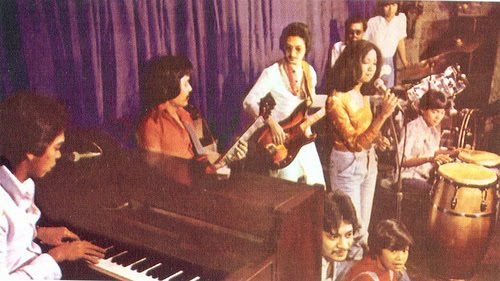
Never felt so high & happy when i first got a hold of this wax 8yrs ago, finally a local jazz funk fusion group called The now batucada. hearing there own version of a Filipino classic traditional song like maala ala mo kaya” made me smile & wonder how great they are as filipino musicians. . recorded there own selftitled album, " Now Batukada" for A&W (Villar) Records. The featured personnel were Boy "Yob" Katindig (keyboards "Papa" Jun Enriquez (guitar), Sonny "Chaba" Nabong (bass), Cesar "Bachu" Yumping (drums), Nick "Egub" Boogie (percussion) a nd Jun "Save Me" Salvame (flute and trumpet). This album also became Boy Katindig's entry to pave his own series of solo albums for A&W.


The batucada band Started out independently & sprung from a group called Bato-Balani (circa 1972), that played at the U.P. Los Baños auditorium and the Thomas Jefferson Cultural Center. also a back up band of bong penera, the batucada meaning (the beat) produced 3 albums, one of them is a record collectors goldmine called "A Samba Song", under the defunkt Penny Rose label & was released in 1976 for distribution by Vicor Records to an enthusiastic record-buying crowd. The spare but inspired effort, featuring Peñera's compositions and arrangements, reflected the influences of Luis Bonfa, Joao Gilberto, Antonio Carlos Jobim, Walter Wanderley and other stalwarts of Samba. They performed regularly in a restaurant/inn called Pension Filipina, situated along the bohemian scene of Jorge Bocobo Street in Ermita, the gathering place for both the art crowd and the young social set.

Recently found out that my elementarys best friend dad was part of this group tito sonny nabong. Which i personaly visit once again at his small humble apartment somewhere in leveriza st. Pasay city . i havent seen him for a long time he was surprised and cant believe that im holding a record which is now totally forgotten, for him it was a product of his youthful ambition ,passion & love for jazz music, he told me a lot of stories about bong's disappearance during one of there there set in hyatt and found him lying down in the grass outside the roxas boulevard alone & drunk while after some time he got into a convent in baguio city which he found & pursue his spiritual calling.. sonny told me his early new York trips where he met a lot of jazz cats dealers dopers poets at that time including legendary bass player ron carter and stories where on & on.. and it made me realized how exciting is the music scene back then, in a way its an exploration of some sorts and at the same time its how they make there living. after couple of hours of talking to him. im glad that i put a smile in his heart with my visit. i asked him to sign my record before i left his place he put hes cigarrete down for a while and waved goodbye as i leave..

Friday, August 27, 2010

Filipino legendary cartoonist Nonoy marcelo In memoriam"


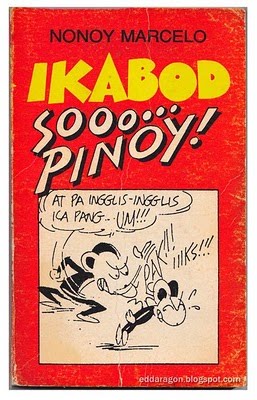
Severino "Nonoy" Marcelo (January 22, 1939 – October 22, 2002) was a Filipino cartoonist born in Malabon, Metro Manila, Philippines, an alumnus of the Institute of Arts and Sciences from Far Eastern University, and a former cartoonist in the The Advocate (the official student publication of Far Eastern University),. best known for creating the character Ikabod Bubwit ("small rodent" in Tagalog) in the comic strip Ikabod. He also created the comic strips Plain Folks, which appeared in the Daily Mirror during the early 1960s, and Tisoy in 1963 for the Manila Times, which tells about the lifestyle of young Filipinos. His main character, Tisoy (slang for "mestizo"), and cast members such as Aling Otik, Maribubut, Caligula, Tatang, Tikyo and Kinse, soon became established in Philippine pop culture. marcelo went to new york in the 70s and took up advance animation for visual arts promoting pinoy pride & culture through underground community magazines with fellow filipino artists. he became a major staff artist at the evergreen review and art director of mcgregor and warner in washington d.c.

Tisoy became a 1977 film directed by Ishmael Bernal, starring Christopher de Leon and Charo Santos.

Nonoy Marcelo's Tadhana (Destiny) is possibly the first-ever full-length animated feature made in the Philippines. Based on a series of volumes on Philippine history officially written by Ferdinand Marcos (unofficially written by a whole team of historians), and produced by his eldest daughter, Imee, the film was broadcast on September 21, 1978--the sixth anniversary of the declaration of Martial Law. It was supposed to be replayed and even have a commercial theater release, but for reasons never made clear that broadcast was it; it was never seen again..

Ikabod ran from the late 1970s to 2002. It was a satirical strip that re-cast the Philippines as a nation called Dagalandia. The strip humorously depicted the socio-political woes of ordinary Filipinos, as represented by the tailless Everymouse hero, Ikabod - who became as iconic in his own way as that other popular cartoon rodent, Mickey Mouse. Marcelo often used the strip to caricature political figures. He was a voracious reader, trivia collector & news addict , he immersed himself in philippine history his last major work was a lovingly illustrated cartoon history of the malabon that he never really left.
Nonoy marcelo inpired a lot of us & continues to inspire more future generations of artists to come.
.

Thursday, July 29, 2010

Kapwa "The self in the other" sikolohiyang pilipino


check this out! it might help you to understand & guide you a little bit of who you really are..


Kapwa " The self in the other"


The filipino reader will find in this book a collection of cultural parables , a map that he may hopefully use to trace his way home from the foreword of randolph s. david

This orientation is called Kapwa The shared self" in the filipino traditional value system, as expounded by sikolohiyang pilipino" (Filipino indigenious cultural bearers)